UNCDF: Investing in the LDCs
UNCDF contributes to the achievement of the Millennium Development Goals in Least Developed Countries through a variety of innovative approaches in both local development and microfinance. UNCDF is well positioned and well suited to address opportunities and constraints for building inclusive financial sectors in the Least Developed Countries (LDCs).
UNCDF is an independent UN organization that works closely with the United Nations Development Programme (UNDP). UNCDF has a unique mandate, which permits it to make investments in the LDCs using grants and loans. UNCDF is the only UN entity working "on the ground" exclusively in LDCs. UNCDF investments are designed to help the LDCs reduce poverty and achieve the objectives of the Brussels Programme of Action for the LDCs.
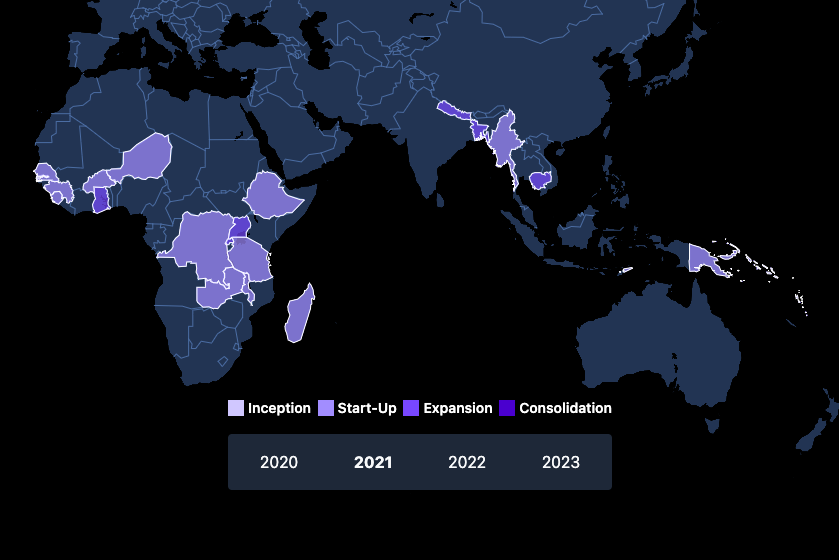
UNCDF currently works in 33 of the 50 LDCs and focuses its investments on local development and inclusive finance with a total programme portfolio amounting to approximately US$130 million. UNCDF offers a unique combination of investment capital, capacity building and technical advisory services. UNCDF's investment capital is flexible, high-risk and innovative.
UNCDF's Vision for Building Inclusive Financial Sectors
UNCDF's vision of inclusive finance is focused on assuring that each of the Least Developed Countries where UNCDF works has a continuum of financial institutions that together offer appropriate financial products and services to all segments of the population. This must be supported by sound policy, legal and regulatory frameworks and is characterized by[1]:
- Access at a reasonable cost of all households and enterprises to a broad range of financial services including savings, short and long-term credit, leasing and factoring, mortgages, insurance, pensions, payments, local money transfers and international remittances;
- Sound institutions guided by appropriate internal management systems, industry performance standards, performance monitoring, institutional transparency, accountability and sound prudential regulation;
- Financial and institutional sustainability as a means of providing access to financial services over time; and
- Multiple providers of financial services, wherever feasible, so as to bring cost-effective and a wide variety of alternatives to customers.
To realize this vision of financial inclusion, financial services for poor and low-income people and micro and small enterprises should be seen as an important and integral component of the financial sector. This sector should include a variety of financial institutions, each with its own comparative advantages, and each presenting the market with a business opportunity.
UNCDF' Financial Inclusion Practice Area (FIPA) made a strategic shift in 2002 to a sector development approach to building inclusive financial sectors. This sector-based approach is in line with the Paris Declaration on Aid Effectiveness[2] and its call for greater national ownership, donor alignment with national strategies, harmonization of donor support and management for results.
Financial sector development programmes are designed to create enabling environments for a variety of retail Financial Service Providers (FSPs). FSPs include commercial banks, Non Banking Financial Institutions (NBFIs), Microfinance Institutions (MFIs), credit unions, cooperatives, insurance providers, money transfer companies, and other institutions providing financial services. This approach also seeks to address gaps in the supportive infrastructure (meso: audit, ratings, networks) and the policy, legal, and regulatory constraints that prevent a financial sector from being inclusive. This results in a dynamic process, tailored to the realities of each country.
UNCDF FIPA: Strategic Objectives for 2008-2011
- Expand UNCDF's support to at least 28 LDCs to develop inclusive financial sectors.
- Support governments, central banks private financial sector, development partners and other key stakeholders in LDCs to establish a shared common vision and approach towards developing an inclusive financial sector. These programmes will address policy, meso and retail level opportunities and constraints. UNCDF will tailor each intervention to meet the specific needs and demands of the country and its level of financial sector development. UNCDF will promote a flexible approach to financial inclusion: helping define national strategies when relevant.
- Provide capacity building and investment support to build sustainable national coverage by FSPs. FIPA will seek to provide capacity-building and capital support to at least 60 FSPs that will have an active client base of more than 6 million clients by 2011, out of which at least 50% are expected to be women. UNCDF will focus investments and capacity building interventions on FSPs with the potential to scale-up their services to under serviced regions, (particularly rural areas) and for under serviced clients (particularly women). UNCDF will seek to leverage development partner expertise and financing. UNCDF will target at least 200 per cent co-financing from development partners and commercial institutions for all FIPA investments.
- Advocate 'Delivering as One' U.N. in the area of inclusive finance through strategic partnerships with IFAD and ILO, and advocating best practices among U.N. agencies at the global policy level and country operations. UNCDF serves as the policy[3] and technical advisor on financial inclusion to UNDP and its Regional and Country Offices. In this capacity, UNCDF works through its Regional Technical Managers who collaborate closely with UNDP Country Offices in design, clearance, implementation and monitoring of inclusive finance and microfinance projects. This advisory work thus extends UNCDF's sector development approach to non-LDCs but does not involve investment in these countries. Although the CGAP portfolio review[4] found UNDP to be weak in microfinance on its own, when combined with UNCDF technical support around a UNCDF designed programme framework, UNDP's prospects for success was considerably stronger. Through partnership, the strengths of both agencies complement and supplement each other.
Key Services Offered by UNCDF's Financial Inclusion Practice Area (FIPA)
- Building Inclusive Financial Sectors in the LDCs:
- Carry out financial sector assessments focused on access by poor and low income people;
- Establish agreement on a Financial Sector Development approach focusing on countries with weak financial sectors that includes supporting a national (private sector, civil society, government) ownership strategy and implementation plans with other stakeholders;
- Suppport to address policy, legal and regulatory constraints to financial inclusion;
- Strengthen the capacity of the supportive infrastructure (audit, networks, ratings) to the financial sector.
- Investing in FSPs in the LDCs and in New Financial Products and Services:
- Establishment of national Investment Committees;
- Supporting a broad range of FSPs to foster competition focusing on those with the potential for scale;
- Willing to take risks in supporting start-up and emerging FSPs;
- Working through a variety of flexible investment instruments;
- Supporting the development of new financial products and services for poor and low-income people and for micro and small enterprises.
- Providing Policy and Technical Advice on Inclusive Finance to UNDP:
- Incorporating "Access to Financial Services" into the UNDP Strategic Plan 2008-2011;
- Formulating, and monitoring implementation of the UNDP Microfinance Policy;
- Working with Regional Bureaus and Country Offices to improve the quality of UNDP inclusive finance programming;
- Reporting on the implementation of the UNDP Strategic Plan.
Comparative Advantage for UNCDF'S FIPA
UNCDF's areas of focus are based on our comparative advantages and where we can deliver. UNCDF continually evaluates these strengths and will exit areas of work when these comparative advantages no longer apply.
- UN Neutrality and Convening Power: As a neutral UN institution, UNCDF, in partnership with UNDP, has access to Government and regulatory officials, FSPs, and FSP Networks, academia, NGOs, and the Private Sector in every country. UNCDF and UNDP also have convening power among all stakeholders in the financial sector.
- Unique Investment Mandate and Geographic Focus on the LDCs: UNCDF's focus on LDCs that have weak financial sectors provides UNCDF with important strategic clarity. Included are many countries in post-conflict recovery, where UNCDF's partnership with UNDP's Bureau for Crisis Prevention and Recovery (BCPR) allows early entry for work on inclusive finance. In the early stages of recovery after conflict, development partner grants or soft loans are critical for building capacity and initiating microfinance lending, savings, and other activities that stimulate economic activity, generate employment, and help reduce poverty.
- National Ownership of Financial Sector Development Programmes: Through its partnerships with Ministries of Finance and Central Banks, FSPs, private sector, Development Partners, civil society and academia, UNCDF is positioned to support multi-stakeholder, participatory processes to develop nationally owned vision statements and/or strategies for building inclusive financial sectors. This shared vision works to delineate the roles and responsibilities of government, development partners, the private sector and other actors in supporting what is essentially a private sector activity.
- Strategic Partnerships with Development Partners: Following the call of the Paris Declaration on Aid Effectiveness for Development Partners to align their support behind national strategies, UNCDF seeks to engage all Development Partners interested in supporting an inclusive financial sector during its initial design of a sector wide approach. This also follows the challenge issued by recent evaluations that 'UNCDF and UNDP as neutral UN agencies could together play a leadership role in developing a shared understanding of financial sector needs and gaps and provide a vision and strategy for bridging challenges.'[5] As a relatively small Fund, this allows UNCDF to leverage its limited resources through the strength of the design work of its technical staff. To date UNCDF FIPA has partnered with the following Development Partners: World Bank, CGAP, European Commission, KfW, DFID, IFAD, CIDA, Luxembourg, SDC, USAID, ILO and Cordaid. UNCDF seeks to continue to expand this list of partners.
- Piloting Agency with Flexible Investment Instruments: UNCDF provides considerable flexibility for direct institutional investments, for piloting, and for taking risks in its investments. UNCDF can easily use its investment instruments (grants, loans, loan guarantees, technical assistance, training) to support what is needed for financial sector development. Grants help build capacity and the capital base of FSPs. UNCDF works to ensure that FSP business plans link to commercial sources of funding so that UNCDF grants do not 'crowd out' but rather engage commercial sources of funds. UNCDF's technical assistance and training instruments are appropriate for work with policy-makers on creating an enabling environment. Loans and loan guarantees are generally provided to start-up and emerging FSPs.
- Strong Staff Capacity: UNCDF has strong in-house technical capacity with an intimate knowledge of local context in the LDCs. UNCDF has a specialized team of senior inclusive finance experts both at headquarters and its two regional offices in Africa. In addition, UNCDF has full time experts in each country of operation. UNCDF enjoys close collaboration with all UNDP country offices in UNCDF's role as UNDP's policy and technical adviser. The UNDP Microfinance Policy[6] requires that UNCDF's 'regional technical experts should collaborate closely with the Country Office in design, implementation, and monitoring of the project'. This strengthens the role of UNCDF's regional advisors and assures that UNCDF and UNDP collaborate closely on all inclusive finance initiatives at country level.
- Accountability for Results: UNCDF is committed to results-based management that combines quality programming with financially sound management. UNCDF's Business Plan[7] sets clear targets to facilitate monitoring and accountability. UNCDF requires target setting in all of its performance based contracts and quarterly reporting on key performance indicators, ensuring transparency and accountability and addressing problems at an early stage. UNCDF's results based management (RBM) mainstreams the principles of best practice into its support to retail financial service providers, including reporting on the MIX Market for transparency of results. In according with UNCDF's Evaluation Policy, all programmes are subject to an independently conducted mid-term and final evaluation.
- Knowledge Management and Information Sharing: UNCDF engages in an active learning agenda to capture lessons from its programming. It utilizes a range of tools for institutional learning (independent evaluations, peer and portfolio reviews, research and publications, staff debate around annual business plans and investments) to develop and share knowledge. UNCDF builds its learning agenda through an active engagement with technical and donor partners. Instead of creating a separate knowledge management and information sharing structure, UNCDF engages other interested partners in the research and shares the outcome of its knowledge management agenda through existing well-recognized platforms, such as CGAP or the ADA managed Francophone website (www.lamicrofinance.org). UNCDF also follows best practices as established by the CGAP Member Guidelines for Donor effectiveness,[8] CGAP Consensus Guidelines and other CGAP publications in its own microfinance policy and operations. UNCDF is committed to the continued training and upgrading of skills of its technical staff so that they stay at the forefront of this rapidly evolving field and provides sufficient resources to staff persons to do so on an annual basis. UNCDF also technically supports the UNDP knowledge network for microfinance.
(1) UNCDF and UNDESA, Building Inclusive Financial Sectors for Development, May 2006
(2) Paris Declaration on Aid Effectiveness, Ownership, Harmonization, Alignment, Results and Mutual Accountability, OECD-DAC, March 2, 2005
(3) See UNDP Microfinance Policy
(4) "MicroStart's "hit rate" of successful projects was 69 percent, which represents strong performance, not only compared to other donors, but also in absolute terms. Microfinance is a risky and demanding business, where even the most skilled donor imaginable cannot expect consistent success." See page 2, " Review of UNDP's Microfinance Portfolio", Richard Rosenberg, CGAP, January 2006.
(5) Independent Impact Evaluation of UNCDF
(6) See UNDP Microfinance Policy
(7) UNCDF Business Plan 2005-2007
(8) See Building Inclusive Financial Systems: Donors Guidelines on Good Practice in Microfinance and Consensus Guidelines
|
|